Monday, May 5, 2025

Will $100M Supreme Court elections be the new normal in Wisconsin? It shouldn’t and doesn’t have to be that way

For release: Monday - May 5, 2025


Image: Billionaire businessman Elon Musk arrives for a town hall meeting wearing a cheesehead hat at the KI Convention Center on March 30, 2025 in Green Bay, Wisconsin. The town hall is being held in front of the state’s high-profile Supreme Court election between Circuit Court Judge Brad Schimel, who has been financially backed by Musk and endorsed by President Donald Trump, and Dane County Circuit Court Judge Susan Crawford. (Photo by Scott Olson/Getty Images)


Guest Commentary by CCWI Director Jay Heck

Published by the Wisconsin Examiner - May 5, 2025


On April 1 Wisconsin voters decisively voted against unprecedented, massive outside interference in our state Supreme Court election by the nearly $30 million from the richest and second (to Donald Trump) most egotistical person in the world – Elon Musk. In handing Musk’s endorsed candidate, Brad Schimel, a more than 10 percentage point, 269,000-vote drubbing, Wisconsinites rendered the nation a great service by humiliating Musk here and thereby driving him from the corridors of power and influence in Washington D.C. where he has been savaging vital U.S. government services and programs that helped the poorest people in our nation and in the world.

Wisconsin also opted to preserve recent democracy reforms in our state by maintaining the current 4-3 progressive majority on the Court. Fairer and more representative state legislative voting maps and the restoration of the use of secure ballot drop boxes for voters will be preserved and the possibility of new and enhanced political reform is possible in the years immediately ahead either through upholding reforms passed legislatively, through court action, or both.

But what can be done about the obscene amount of political money raised and spent to elect a new Wisconsin Supreme Court Justice in 2025 – as much if not more than $105 million – by far the most amount ever spent in a judicial election in the history of the United States? Wisconsin faces new state supreme court elections every April for the next four years and a continuation of such frenzied and out of control spending for the foreseeable future seems both unbearable and unsustainable.

Voluntary spending limits for Supreme Court candidates with the incentive of providing them with full public financing if they agree to statutory spending limits is a possibility. Wisconsin actually had such a law in place for exactly one Supreme Court election in 2011. The Impartial Justice Act was made possible by passage with overwhelming bipartisan majorities in the Wisconsin Legislature and enactment into law in 2009. In 2011, both candidates for a seat on the high court agreed to the voluntary spending limits of $400,000 each and received full public financing. That campaign was robust, competitive and the result was close, which is what you would expect in Wisconsin. And it cost just a tiny fraction of the more than $100 million that was spent in 2025.

Unfortunately, later in 2011, then-Gov. Scott Walker and the Republican-controlled Wisconsin Legislature defunded the Impartial Justice Act and all other public financing for elections. Four years later, Walker and the GOP completely eviscerated and deformed Wisconsin’s campaign finance laws. They did away with limits on what political parties and outside groups can raise and spend in elections, increased individual campaign contribution limits and, most alarmingly, legalized previously illegal campaign coordination between so-called issue ad spending groups and candidates, which greatly increased opportunities for corruption and undue influence through campaign spending. Disclosure requirements were weakened and, in some instances, dismantled altogether.

In just four short years, Wisconsin was transformed from one of the most transparent, low spending and highly regarded election states in the nation to one of the worst, least regulated special interest-controlled political backwaters in the nation, akin to Texas, Louisiana or Florida.

This current corrupt status quo will remain in place for the upcoming state Supreme Court elections in 2026, 2027, 2028 and 2029 unless the governor, Legislature and the Wisconsin Supreme Court take action and do the following:

  • Re-establish an “impartial justice” law for the public financing of state Supreme Court elections modeled after the 2009 law which was in place for only one election before it was repealed. Update and revise it to better fit current times and circumstances including more realistic spending limits and higher public financing grants.
  • Establish clear recusal rules for judges at all levels in Wisconsin that clearly decree that if a certain campaign contribution is reached or surpassed beyond a certain threshold amount, then the beneficiary of that contribution (or of the expenditure against her/his opponent) must recuse from any case in which the contributor is a party before the court.
  • Restore sensible limitations on the transfer of and acceptance of campaign funds and make illegal again campaign coordination between outside special interest groups engaged in issue advocacy with all candidates for public office — particularly judges.
  • Petition the U.S. Supreme Court to reverse the disastrous 2010 Citizens United vs F.E.C. decision which ended over 100 years of sensible regulation of unlimited corporate, union and other outside special interest money in federal and by extension state elections, unleashing the torrential flood of campaign cash drowning democracy today.

These are common-sense, achievable reforms that, if enacted into law, would go a long way toward restoring desperately needed public confidence in the fairness, impartiality and trust in Wisconsin’s courts and in particular, our Wisconsin Supreme Court which was regarded as the model for the nation and the best anywhere a quarter century ago. But it will take determined action by all three branches of Wisconsin’s state government working together with the voters to uphold election integrity and curb corruption in a way all of us can embrace.

Ultimately, of course, it’s up to us, the voters, to hold our governmental institutions accountable and ensure that they work for us instead of for their own narrow interests  and those of the donor class. In this critical season of resistance and defiance against tyranny — speak up, make noise and ensure that your voice is heard. Demand real reform and an end to the corruption of our representative government.

--------------------------


Jay Heck
608/512-9363 (cell)

Common Cause in Wisconsin
152 Johnson St, Suite 212
Madison, WI 53703

Read More...


Tuesday, April 30, 2024

To be truly fair Wisconsin courts must be free from big political money

For release: Tuesday - April 30, 2024


Image: A Gavel


"We went from being the progressive good government promised land to the political wasteland of the country."


The Wisconsin Examiner released Jay Heck's guest commentary piece on 4.29.24.


The April 12 announcement by Wisconsin Supreme Court Justice Ann Walsh Bradley, our state’s longest serving and most respected and distinguished court member, that she will not run for re-election in 2025, sent shockwaves through the political biosphere.

Next year’s spring election was already expected to be hugely expensive and fiercely contested.  But now, with the three-term justice bowing out, the stakes for ideological control of Wisconsin’s highest court are even greater. The price tag of the April 2025 election to succeed Justice Bradley is universally predicted to exceed the astronomical $57 million spent in 2023 in Wisconsin between current Justice Janet Protaciewicz and her opponent, former Justice Daniel Kelly — by far the largest amount of money ever spent in any state supreme court election in American history.

The unprecedented and obscenely high amount of political money being raised and spent in Wisconsin Supreme Court elections is a fairly new and horrific development in our state. It wasn’t always this way here and it cannot and should not continue. 

When I started with Common Cause in Wisconsin in 1996, the Badger State was still considered to be the national beacon for democracy, competitive but civil political discourse and clean elections and — most notably — was said to have the best, most impartial and least corruptible system of courts, at all levels, in the nation.  

The Wisconsin Supreme Court, led by Chief Justice Shirley Abrahamson, was looked upon as the gold standard for how a state’s highest court should be elected and how it should conduct itself in the dispensation of justice to its citizens. It was widely respected, admired and even revered.   

The Supreme Court in turn set the tenor, tone and standard for Wisconsin’s Court of Appeals, circuit courts and municipal courts — all also widely praised and heralded.

Among the foremost champions in the nation for democracy and of free and fair elections, Wisconsinites decided long ago that our judges at all levels should be elected by the citizenry — not appointed or selected by a singular, select public official or by some elite entity. And so, since achieving statehood in 1848 Wisconsin has held nonpartisan elections for judges, almost invariably in the spring when voter turnout is never as robust as it is in partisan, November elections.

For many years the system worked well in Wisconsin. Elections for the Wisconsin Supreme Court were relatively tame and civil affairs where candidates were judged on their impartiality and on their judicial qualifications and temperament. Political affiliation and partisan leanings were not only downplayed, they were discouraged and much frowned upon. The central focus of Wisconsin Supreme Court candidates was on their impartiality and ability to uphold that long-held legal principle that justice is or should be blind, that courts should not make judgments based on appearance or on pre-ordained political disposition. What was prized above all by voters was the behavior any citizen would want and expect from a justice: that she or he be fair and impartial. 

But beginning in 2007 Wisconsin Supreme Court elections experienced a seismic shift. Partisan conservative special interest groups led by Wisconsin Manufacturers & Commerce (WMC) cynically calculated that buying influence with the Wisconsin Supreme Court was at least as important and far more cost effective than trying to buy a friendly legislative majority. And so they began pouring hundreds of thousands of dollars, most of it secret or “dark” money into judicial races to support candidates for the high court they deemed sufficiently “business friendly.”  

In 2009, the conservative majority on the Wisconsin Supreme Court also adopted a new recusal rule for justices and judges who were the recipients of campaign contributions.  In many other states in the nation, justices and judges must step away from and not participate in cases where one or more of the parties has contributed to that judge beyond a determined threshold, for the very rational and evident reason that a larger campaign contribution likely had an influence on the recipient and that transaction thereby created a conflict of interest for the justice or judge.  

But the Wisconsin Supreme Court majority adopted verbatim a recusal rule written by WMC which was essentially that no recusal at all is required if a campaign contribution is received. It is up to each justice or judge to decide whether or not to step aside. As a result, according to a 2014 study of judicial recusal rules across the nation, Wisconsin had the 47th weakest such rules of the 50 states. That “self-recusal” standard remains in place today.

The Wisconsin Legislature and former Gov. Jim Doyle reacted to the shocking special interest spending frenzy by deep-pocketed special interest groups in the 2007 and 2008 Wisconsin Supreme Court elections by enacting into law sweeping and effective bipartisan campaign finance reform legislation — the Impartial Justice Act of 2009 — which imposed voluntary spending limits of $400,000 on candidates for the high court in return for full public financing of their campaigns – and no solicitation of private contributions. With no private money flowing into their campaigns, justices could be truly impartial and beholden to no campaign donor other than to the public. 

The new law was the most advanced and sweeping of any judicial campaign finance system in the nation and a model for clean elections and in reducing the influence of money on the judiciary.

But less than 18 months later in 2011, incoming Gov. Scott Walker and the new Republican legislative majority repealed the Impartial Justice Act and went even further by ending the 30-year-old partial public financing system and spending limits for all other state elective offices.

And then in 2015, Walker and the GOP-controlled Legislature took an axe to the remaining safeguards and limitations in Wisconsin’s campaign finance law, including lifting virtually all limits on special interest money that could be raised and spent, weakening disclosure requirements and, most alarmingly, legalizing campaign coordination between special interest groups running phony issue advocacy communications with candidates — including Supreme Court candidates.

This insidious coordination had long been prohibited in Wisconsin and still is in almost every other state in the nation and in federal elections.

In less than a decade, between 2007 and 2015, Wisconsin was transformed from one of the more transparent and least “big money influenced” political campaign systems in the nation to one of the states with the least transparent disclosure requirements, corrupted by outside big dollar special interest groups and big donors. 

We went from being the progressive good government promised land to the political wasteland of the country.  

While there likely is not a lot that can or will be done to improve and reform Wisconsin’s judicial elections before the next state Supreme Court contest in April 2025, political leaders of all ideological stripes ought to begin to think about how to change the corrupt status quo.  Here are a few suggestions for inclusion in the necessary clean-up:

  • Re-establish an “impartial justice” law for the public financing of state Supreme Court elections modeled after the 2009 law which was in place for only one election before it was repealed.  Update and revise it to better fit current times and circumstances including more realistic spending limits and higher public financing grants.
  • Establish clear recusal rules for judges at all levels in Wisconsin that clearly decree that if a certain campaign contribution is reached or surpassed beyond a certain threshold amount, then the beneficiary of that contribution (or of the expenditure against her/his opponent) must recuse from any case in which the contributor is a party before the court.
  • Restore sensible limitations on the transfer of and acceptance of campaign funds and make illegal again campaign coordination between outside special interest groups engaged in issue advocacy with all candidates for public office — particularly judges.
  • Petition the U.S. Supreme Court to reverse the disastrous 2010 Citizens United vs F.E.C. decision which ended over 100 years of sensible regulation of unlimited corporate, union and other outside special interest money in federal and by extension state elections, unleashing the torrential flood of campaign cash drowning democracy today.

Wisconsin needs to begin to figure out a better way to elect state Supreme Court justices and judges at all levels and those discussions need to begin in earnest now.  The upcoming 2025 state Supreme Court election to replace Justice Ann Walsh Bradley has already begun.  But there will be no rest for the weary as more equally critical state Supreme Court elections follow in April 2026, 2027, and 2028.

We cannot continue down the current path. If there is no change a $100 million election is in our immediate future. We can and must do better. Wisconsin enacted bipartisan legislation to fix our state Supreme Court elections in 2009 and we can and should again.  

--------------------------

Jay Heck
608/512-9363 (cell)

Common Cause in Wisconsin
152 Johnson St, Suite 212
Madison, WI 53703
www.commoncausewisconsin.org

Read More...


Monday, December 5, 2022

The November 8th Election was Significant and Important…

For release: Monday - December 5, 2022


  Image: Entry to the Wisconsin Supreme Court Chamber at the Wisconsin Capitol 

But Now is Not the Time to Disengage from Wisconsin Politics

The “mid-term” elections in Wisconsin last month have been all but finalized and, apart from the extreme hyper partisan gerrymandering of state legislative districts, the results demonstrated what Wisconsinites have known for years: we are an evenly divided, 50/50 state.


Gov. Tony Evers was re-elected with about 51 percent of the vote to Republican Tim Michel’s 49 percent and statewide elections for Attorney General, Secretary of State and State Treasurer were even closer. In the U.S. Senate election, incumbent G.O.P. Senator Ron Johnson very narrowly bested Lieutenant Gov. Mandela Barnes by just over 27,000 votes out of more than 2.6 million cast, less than one percent.


Significantly, all of the runner-up contestants in these elections gracefully conceded to the winners and there has been no baseless conspiracy theory-driven election denialism in Wisconsin like that of former President Donald Trump, former Wisconsin Supreme Court Justice Michael Gableman and others in Wisconsin as well as in several other states after the 2020 election.


Voter interest was robust and turnout was high for November 8th. More than 58 percent of Wisconsinites eligible to vote this year cast ballots, the second highest level of voting in a non-presidential year in the 21st Century, although slightly less than in 2018. This relatively high level of voter participation occurred even in the face of increased barriers to voting put in place in 2022. These included the elimination of secure voter drop boxes for the return of absentee ballots and the prohibition placed on election clerks correcting simple address mistakes or omissions for witnesses signing absentee ballot certificates. Voter turnout presumably would have been even higher absent these unnecessary barriers to voting.


Election poll workers and clerks did an outstanding job of conducting the 2022 elections which were, with a very few isolated and rare exceptions, carried out without problems, disruption, incidents or controversy. Wisconsinites voted the way all of us hoped they would – in sizable numbers and with determination and conviction. And they had faith in and accepted the outcome.


Lest we think our duty to democracy at the polling place is “done” for another two years, however, think again!


While it is true that 2024 will bring another Presidential election, as well as another U.S. Senate election in Wisconsin and for the U.S. House of Representatives and the Wisconsin Legislature, one of the most important and consequential elections in Wisconsin’s recent history is less than five months away. The eyes of the entire country will be focused on a single Wisconsin Supreme Court election that will determine the composition of the majority on that court and could have enormous implications for the outcome of the U.S. Presidential election of 2024.


Furthermore, now that the U.S. Supreme Court has largely ceded to state courts the power to determine state legislative redistricting, the Wisconsin Supreme Court could conceivably revisit the unprecedented partisan gerrymandering of the state’s Assembly and State Senate districts in 2021-22. The Wisconsin Supreme Court will also have enormous power to determine how elections are conducted, what health care decisions are made, how taxes and state and local funding decisions are determined and in almost every other conceivable policy affecting the lives of each and every Wisconsinite for years to come.


National attention will thus be concentrated on what happens here during the next four months leading up to the April 4th general election for a single seat on the Wisconsin Supreme Court. Millions upon millions of dollars – most of it no doubt undisclosed, unregulated and from out of state – will pour into Wisconsin to try to influence state voters on the airwaves, in print media, on the internet, in the U.S. Mail and on the “ground” from now until April. The nearly complete deregulation and elimination of any sensible limits on and transparency of political money by the Wisconsin Legislature and then-Gov. Scott Walker in 2015 have set the stage for this massive upcoming assault on our senses and sanity for the next four months. It is critical that all of us engage and participate no matter how ugly things get.


This election is expected to be like most statewide elections in our state – very hotly contested and evenly divided. Four candidates have already jumped into the contest. The press has identified two as being conservatives and two as progressives. The field will be winnowed to the final two in the February 21st primary election. Voter turnout in Spring elections in Wisconsin is typically much lower than those in November. That means that every vote matters even more and is amplified in importance.


With so much at stake for Wisconsin and for the nation in the upcoming Wisconsin Supreme Court election, all of us have a duty to become involved and informed about the candidates, the issues and to be concerned about the outcome. Postpone your post-election rest and relaxation until April 5th. The future of our democracy depends on your active engagement in this matter in the months immediately ahead.

--------------------------

Jay Heck
608/256-2686 (office)
608/512-9363 (cell)

Common Cause in Wisconsin
152 Johnson St, Suite 212
Madison, WI 53703
www.commoncausewisconsin.org

Read More...


Monday, April 18, 2022

Wisconsin Supreme Court Embraces Hyper Partisanship and Polarization in Choosing State Legislative Voting Maps

 
Monday - April 18, 2022


Editorial Cartoon by Phil Hands of the Wisconsin State Journal – 6/30/19


Late on Friday afternoon, as families all over Wisconsin were making preparations for two of the most important religious observances of the year -- Easter and Passover -- or, just beginning what was hopefully a warmer, Spring weekend, the Wisconsin Supreme Court chose to release its shockingly unfair, hyper partisan, and completely misguided decision regarding the state legislative redistricting process and voting maps and set the stage for yet another decade of deeply polarized, undemocratic and unrepresentative state government in Wisconsin.

The four "conservatives" on the court committed an act of unprecedented radical judicial activism in selecting the ultra-partisan gerrymandered voting maps drawn in secret by state legislative Republicans less than six weeks after having chosen the less partisan, fairer voting maps submitted to the court by Governor Tony Evers.

The U.S. Supreme Court, on March 23rd had remanded Wisconsin's state legislative voting maps back to the Wisconsin Supreme Court for additional information, explanation and possible slight revision saying that in expanding to seven, from the current six the number of majority-minority Assembly districts in Wisconsin, the Governor needed to show more evidence that his maps did not constitute a "racial gerrymander" and were fully compliant with the Voting Rights Act. This, Evers said he was willing to do. Another way to address the concerns of the conservative majority on the U.S. Supreme Court about utilizing race-based redistricting might have been to revise only the majority-minority districts (all in the Milwaukee area) and reduce the number of them from seven in the Governor's plan, back to six. The rest of the state legislative districts drawn by Evers were not at issue and could have been left intact.

But in what may be remembered in our state as the "Good Friday Surprise Attack on Democracy," the Wisconsin Supreme Court chose another path. And it was the worst possible alternative. Conservative Justice Brian Hagedorn, who had led the court in choosing the Governor's redistricting plan because it most closely adhered to his "least change" (from the 2011 redistricting) directive, on Friday executed a 180-degree pivot, and chose the severely partisan and even more gerrymandered (than in 2011) Republican state legislative maps, dishonestly claiming the court "had no other choice." That declaration was as absurd as it was untrue.

The Wisconsin Supreme Court could have accepted and reviewed the additional evidence that Gov. Evers offered to provide about how he determined the addition of a majority-minority Assembly district in his redistricting plan. It rejected that offer. The court could have made some revisions to the composition of the majority-minority districts to address the concerns of the U.S. Supreme Court about a "race-based" redistricting scheme. It refused to do so. Instead, Justice Hagedorn joined conservative justices Annette ZieglerPatience Roggensack, and Rebecca Bradley in selecting the most unfair, hyper partisan redistricting plan available that is specifically designed to lock in absolute Republican control of the Wisconsin Legislature for the next decade and to achieve for the Republicans a veto-proof, supermajority in at least one of the two legislative chambers.

Some legal experts have said that there is very little or no precedent for a state or federal court to have made such a partisan, completely unbalanced redistricting choice as the 4 to 3 conservative majority on the Wisconsin Supreme Court made on Friday. There is no precedent for a court selecting a redistricting scheme that was legally vetoed by a Governor, ignoring that action, and then ramming it into effect, without any revision or compromise whatsoever. This will likely go down as one of the worst assaults on justice and fairness in the history of American jurisprudence.
 
Wisconsin Justice Jill Karofsky, a progressive, got it right in the dissent she wrote, and which was joined by progressive Justices Ann Walsh Bradley and Rebecca Dallet. Karofsky argued the court's majority had ignored a long history of racism in Milwaukee, one of the most segregated cities in the nation where Black residents have long faced racial disparities in homeownership, education, employment, health care and the criminal justice system. "The fault and responsibility to remedy this systemic segregation lies not with Milwaukee's residents but instead with the government and the society that perpetuated racial redlining and restrictive covenants," Karofsky wrote. "Those practices shaped Milwaukee and that history of discrimination cannot be undone by force of will alone."
 
The Governor's plan attempted to address and correct some of that disparity and injustice in expanding from six to seven the number of majority-minority Assembly districts. The Republican plan adopted by the court majority decreases to five, the number of majority minority Assembly districts and enhances racial disparity and injustice. Rather than address this issue and attempt to alleviate the problem as one might reasonably expect a fair and impartial state supreme court to do, the Wisconsin Supreme Court voted to wash its hands of any responsibility for this blight on our state. Instead, they exacerbated the problem.
 
Common Cause in Wisconsin has long advocated for and supported the adoption of a non-partisan redistricting process for Wisconsin based on our neighboring state of Iowa's 42-year-old non-partisan process with which, even with Republican state legislative majorities and a Republican Governor in power, earlier this year adopted non-partisan state legislative and congressional voting maps that were supported by almost every Democratic and Republican member in both chambers of the Iowa Legislature.
 
Contrast that process and outcome with Wisconsin's, which with this horrendous state supreme court decision, has once again earned the dubious distinction of being one of the most hyper partisan, polarized and unfairly gerrymandered state of any in the nation. And lest there be any question that this is simply a "Republican problem," it most definitely is not. Democratic legislative majorities with Democratic Governors this year rammed through hyper partisan, unfair state legislative gerrymanders in Illinois and New York every bit as egregious as the G.O.P. assault on fairness and democracy in Wisconsin.
 
The long-suffering citizens of Wisconsin clearly deserve much better than the Wisconsin Supreme Court and the Wisconsin Legislature have been willing or able to deliver. We will continue our relentless pursuit of non-partisan redistricting reform for our state for as long as it takes to achieve it. It will be up to "we the people" to make the necessary changes to restore some modicum of liberty and justice for all of us. And we cannot and will not rest until we do.
 
Onward,
Jay Heck
 
--------------------------

Jay Heck
608/256-2686 (office)
608/512-9363 (cell)

Common Cause in Wisconsin
152 Johnson St, Suite 212
Madison, WI 53703
www.commoncausewisconsin.org

Read More...


Friday, April 8, 2022

Actions You Can Take to Promote and Protect Democracy

Friday - April 8, 2022


WE Power - democracy is our common cause

You can continue to make a difference this year in Wisconsin to strengthen fair and free elections!


Thanks to each and every voter who participated in the Spring 2022 elections! Local elections have direct impacts on our lives, families, and communities. Thanks for using your personal power to make a difference and to enhance our right to vote.

Now, with our next statewide election just ahead in August, here are some exciting, upcoming opportunities for you to learn, explore, and help direct your citizen activism to preserve and protect our freedom to vote.


CALLS to ACTION (write to your government officials TODAY, which is easy to do with the Common Cause online writing tool)
  • The anti-voter legislative bills have been sent to Governor Tony Evers. He needs to veto these measures. Write to him today to thank him for defending our right to vote because he will need to act on these bills by early next week. Even if you have done this in the past on earlier voter suppression measures, it’s important that you weigh in against this latest assault on free and fair elections in Wisconsin. And it takes only a few minutes to construct and send out this important message by using this easy-to-use Common Cause letter writing tool.
  • Write to both your State Senator and your State Representative and demand a public hearing and then a vote on SB 389 and AB 395 in support of redistricting reform. While the Wisconsin Legislature has "adjourned" for the year to campaign for the 2022 elections, they could easily convene again in Extraordinary Session to consider and pass SB 389/AB 395. Demand that they do so - write to them today!


What's Undermining Our Courts? (webinar)

Common Cause Wisconsin Director, Jay Heck, joins a panel with Marquette University Law Prof. Edward Fallone and dark money expert Lisa Graves for a conversation moderated by former Wisconsin Public Radio personality Joy Cardin about how secret, dark political money and weak recusal rules are undermining our courts. The free, virtual event sponsored by LWVWI is this coming Wednesday, April 13 at Noon.

Register for the Fair Courts webinar. The recorded event will be posted on the League's website and YouTube page.


Thank Election Heroes Day (online)
 
Join Common Cause Wisconsin, many partnering organizations, and voters across the state to thank our local clerks, poll workers, and election officials for all their work for ensuring Wisconsin elections are secure, fair, free and accessible. Send your clerk a letter, email or message via social media on Tuesday, April 12 -- "Thank Election Heroes Day." Let's all come together to thank our election workers and let them know how grateful we are that they count every vote and protect our freedom to vote. A little kindness from you goes a long way toward making democracy better!
 
You can find your clerk's contact information at MyVote.wi.gov

 
VoteRiders Voter ID Clinic/10th Anniversary Party (in person event)
  
On Tuesday, April 19 at 3:00 pm CT, Vote Riders will be kicking off our first Wisconsin Voter ID Clinic for 2022 in Milwaukee! Join them to celebrate 10 years and for ID clinic to give for assistance with IDs, Social Security Cards, Birth Certificates, and more! Refreshments will be served.

Milwaukee Public Library - Central Branch
Rotary Club of Milwaukee Community Room
814 W Wisconsin Ave, Milwaukee, 53233
 
Contact Nick Ramos, Vote Rider WI Voter ID Coalition Coordinator for more information.


Prepare NOW to VOTE in August and November 2022 Elections! (vote by absentee ballot or on Election Day)

If you have moved and/or need to update your voter registration, there's no better time than right now to do that so you're ready for the next election. Go to MyVote.wi.gov and enter your address information or contact your municipal clerk. You can find more voting information at the Common Cause Wisconsin website including resources for how to get assistance and answers for your election questions.


Please take action now and participate in one or more of these opportunities to move your civic engagement from beyond just the voting booth.

Stay involved. Stay encouraged. Stay connected!

Your active engagement makes our democracy stronger and preserves our freedom to vote and have our voices heard.

Thanks, and all best to you,
Jay Heck
 
--------------------------

Jay Heck
608/256-2686 (office)
608/512-9363 (cell)

Common Cause in Wisconsin
152 Johnson St, Suite 212
Madison, WI 53703
www.commoncausewisconsin.org

Read More...


Tuesday, January 18, 2022

Wisconsin Voting Maps Before the Wisconsin Supreme Court on Wednesday

Tuesday - January 18, 2022


(Tasos Katopodis | Getty Images)


 What Citizens Can Do


Late last year in November, majority Republicans rammed through the Wisconsin Legislature hyper partisan state legislative and congressional district voting maps in a redistricting process that was even more partisan and unfair than in 2011, when Wisconsin was the victim of the most partisan gerrymander in the nation.


Then, on November 30th, the narrow, conservative 4 to 3 majority on the Wisconsin Supreme Court issued a deeply flawed and completely misguided decision regarding the criteria it says it will utilize to determine what Wisconsin's state legislative and congressional district maps will look like for the next ten years. The 2021-22 redistricting process went to the state supreme court after Gov. Tony Evers, on November 18th, vetoed the hyper partisan, extremely gerrymandered voting maps that were rammed through the Republican-controlled Wisconsin Legislature without a single Democratic vote earlier in November.


The G.O.P. maps, drawn in secret with almost no public input and without a single person (other than Assembly Speaker Robin Vos and State Senate Majority Leader Devin LeMahieu) speaking or registering in support of them at the October 28th public hearing, are an updated version of the maps passed by Republicans in 2011 when, as mentioned before, they perpetrated the most extreme and partisan gerrymander in the nation that year.


The conservative majority Wisconsin Supreme Court "opinion" of November 30th was deeply flawed and illogically reasoned -- the work of ultra-right wing Justice Rebecca Bradley, whose completely fabricated concept of "least change" as the basis for adjudicating state legislative and congressional voting maps has no legitimate basis in either law or logic. Dissenting progressive Justice Rebecca Dallet pointed out that “no court in Wisconsin, state or federal, has ever adopted a least-change approach.” She went on to say, “The least-change principle is found nowhere in the Wisconsin or U.S. Constitutions.” In other words, Rebecca Bradley concocted a brand-new concept, based in fiction, purely to support extreme Republican- gerrymandered voting maps.


Bradley also completely misinterpreted a U.S. Supreme Court majority decision more than three years ago in Rucho v. Common Cause in which Chief Justice John Roberts basically "punted" partisan gerrymandering to the states because he didn't want federal courts playing such a major role in redistricting cases. But Bradley opined that the Wisconsin Supreme Court shouldn't consider extreme partisanship in adjudicating state legislative and congressional voting maps because partisanship was a legislative matter, not one that courts ought to consider. That directly contradicts what Roberts and the conservative majority on the U.S. Supreme Court ruled -- that it is precisely the province of state courts, like the Wisconsin Supreme Court, to judge, whether, a redistricting process is too partisan, unfair and/or unjust. Rebecca Bradley and the three other conservatives on the Wisconsin high court badly but deliberately botched this decision.


The Wisconsin Supreme Court will consider redistricting proposals and hear oral arguments tomorrow, Wednesday 1/19, before issuing a final determination -- perhaps by the end of this month -- of how the state legislative and congressional voting maps will look for the 2022 election and beyond. Whether or not and to what extent federal courts may intervene in this matter isn't clear right now. But we shouldn't expect that a federal court will contradict the misguided Wisconsin Supreme Court's apparent intention to extend extreme partisan gerrymandering in Wisconsin for another decade.


If you would like to view these oral arguments, they will commence at 9:00 AM tomorrow on Wisconsin Eye. Use this link (Schedule - WisconsinEye) and scroll down to Wednesday, January 19 - Wisconsin Supreme Court Oral Arguments and click the "Live" link at the end.


What can be done to counter the disgust and dismay that most Wisconsinites feel right now about what the gerrymandered Republican majority in the Wisconsin Legislature and now, the conservative activists on the Wisconsin Supreme Court have done to defy the will of the people and extend and cement into place their rigged voting maps for another ten years? The answer is clear and simple. We must redouble our effort and determination to change the current corrupt status quo.


Obviously, the current redistricting process in Wisconsin is completely in need of reform, as we have been advocating for years now. The antidote to this poisonous gerrymandering has long resided in our neighbor to the west, Iowa, which adopted a fair, non-partisan redistricting process way back in 1980. And, it was put into place by a Republican Governor and a Republican-controlled Legislature there.


Legislation, with bipartisan support, to establish a similar process in Wisconsin, has been introduced in the last seven legislative sessions and has not received so much as a public hearing since 2009! Here is what you can do: contact both your State Senator and your State Representative and demand that they support the bipartisan redistricting reform legislation introduced in the Wisconsin Legislature in June based on our neighboring state of Iowa's non-partisan redistricting process. Senate Bill 389 and Assembly Bill 395 is the "Iowa Model" legislation whose lead sponsors are State Sen. Jeff Smith and State Rep. Deb Andraca, who discussed the measures in the August 17th CC/WI webinar.


It is simple and very easy to use the tool Common Cause developed to write to both your State Senator and your State Representative and demand a public hearing and then a vote on SB 389 and AB 395 in the weeks ahead, before the 2022 election season kicks into high gear. Take less than a minute and do it now, even if you have before, because repeating your demand for reform is effective and necessary. You will feel better for doing so!


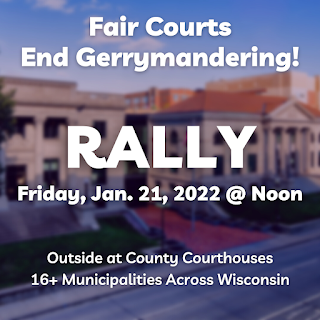
Our partners with the Fair Maps Coalition are organizing "in-person" rallies in front of county court houses throughout Wisconsin to be held simultaneously beginning at 12 Noon this coming Friday, January 21st to demonstrate public support for fair and impartial consideration of redistricting and fair voting maps before the Wisconsin Supreme Court. While CC/WI is not directly involved in these rallies, we wanted to make the information available to those of you who feel comfortable gathering safely (with masks and socially distanced) outside at various locales throughout the state to participate. For more information and/or to sign up for one of these rallies, go here.


A final decision by the Wisconsin Supreme Court on redistricting for 2022 is not the end of this process or this fight for fair voting maps. We will never cease to insist on a non-partisan redistricting system for Wisconsin until that objective has been fully realized. The struggle for fairness and justice almost always takes years and often decades before it is achieved. We are much further along the road toward our goal of ending partisan gerrymandering than we were just ten years ago. Rather than despairing or losing hope, instead take action! There is no "magic bullet" that is going to fix this. Just determination, hard work and perseverance. We're in it for the long haul and hope you will be too.


On Wisconsin!


--------------------------

Contact: 
Jay Heck
608/256-2686 (office)
608/512-9363 (cell)

Common Cause in Wisconsin
152 Johnson St, Suite 212
Madison, WI 53703
www.commoncausewisconsin.org

Read More...